May 06, 2026 | Arpit Jain
Private Limited Company Registration in India 2026: Complete Step-by-Step Guide
A step-by-step guide to Private Limited Company registration in India in 2026 covering the latest MCA updates, eligibility, required documents, SPICe+ process, costs, and post-incorporation compliance.
Private Limited Company Registration in India 2026: Complete Step-by-Step Guide
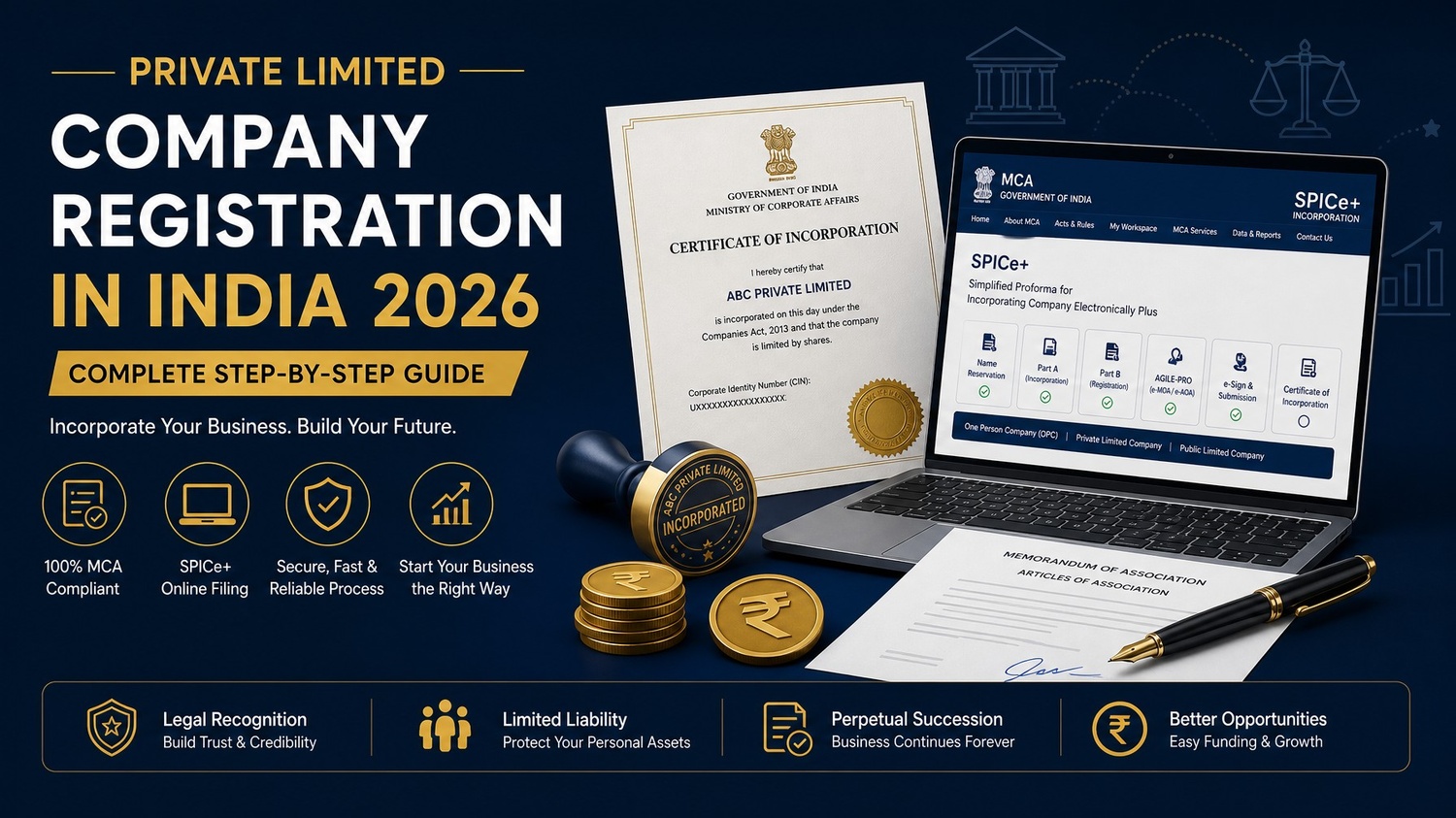
Registering a Private Limited Company in India in 2026 is faster than ever thanks to MCA's SPICe+ simplification — but getting it wrong still leads to rejection, penalties, and costly restructuring. The process covers DSC, DIN, name reservation, MOA/AOA drafting, SPICe+ filing, and post-incorporation compliance. A professional can complete it in 3 to 7 working days with the right documents in hand.
Table of Contents
What Is a Private Limited Company?
Why Choose a Private Limited Company?
Latest MCA Updates for 2026
Eligibility Requirements
Documents Required
Step-by-Step Registration Process
Private Limited Company Registration Fees in 2026
Post-Incorporation Compliance
Common Mistakes to Avoid
How MagicEfiling Can Help
FAQs
What Is a Private Limited Company?
A Private Limited Company (Pvt Ltd) is a business entity registered under the Companies Act, 2013. It is privately held, meaning shares cannot be publicly traded on a stock exchange. Ownership is limited to a maximum of 200 shareholders, and each shareholder's liability is capped at the value of their shareholding — personal assets stay protected.
This makes a Pvt Ltd the most popular choice for startups, entrepreneurs, and growing businesses in India that want legal credibility without the complexity of a public company.
Why Choose a Private Limited Company?
A Pvt Ltd gives your business a structure that opens doors others cannot.
Separate Legal Entity: The company can own assets, enter contracts, and sue or be sued in its own name — independent of its founders.
Limited Liability: Shareholders are not personally liable for the company's debts beyond their share capital contribution.
Perpetual Succession: The company continues to exist regardless of changes in ownership, directors, or shareholders.
Easier Access to Funding: Banks, venture capitalists, and angel investors strongly prefer lending to or investing in registered companies. A Pvt Ltd signals seriousness and legal accountability.
Tax Benefits: Pvt Ltd companies can take advantage of corporate tax rates, startup tax exemptions, and deductions not available to individuals or partnerships.
Ownership Transferability: Shares can be transferred to new investors or employees, making equity distribution straightforward. Source: ClearTax
Latest MCA Updates for 2026
The Ministry of Corporate Affairs (MCA) proposed significant changes in April 2026 to simplify incorporation and improve ease of doing business. Here is what changed:
E-Form Simplification
Multiple forms are being merged into consolidated e-forms like E-CHNG and E-CON, reducing duplication and filing complexity.
Up to 5 DINs Allowed
Earlier capped at 3, the system now allows up to 5 Director Identification Numbers (DINs) to be applied during a single incorporation — a major benefit for startups with multiple co-founders.
DIR-2 No Longer Required Separately
Director consent is now "deemed" through the SPICe+ form itself, eliminating a separate document from the process.
Flexible Registered Office Proof
Co-working spaces, leased offices, and owned premises are all clearly accepted, with broader documentation options including utility bills and municipal records.
Risk-Based Verification
Physical verification of offices is no longer mandatory for all companies. MCA conducts it based on a risk assessment, speeding up approvals for most applicants.
AGILE-PRO-S Services Made Optional
EPFO registration, ESIC registration, and bank account opening through SPICe+ are now optional — giving founders flexibility to set up only what they need at incorporation. Source: Prakasha & Co.
Eligibility Requirements
Before starting the registration process, verify you meet the basic requirements:
| Requirement | Detail |
|---|---|
| Minimum directors | 2 (maximum 15) |
| Resident director | At least one director must be a resident of India |
| Minimum shareholders | 2 (maximum 200) |
| Directors and shareholders | The same individuals can hold both roles |
| Minimum capital | No minimum — start with any amount suitable for your business |
| Registered office | A valid India address (owned, rented, or co-working) |
| DINs | Up to 5 can now be applied in a single incorporation |
Documents Required
Prepare these before initiating the process:
For Directors and Shareholders
PAN card (mandatory for all)
Aadhaar card
Passport-size photograph
Bank statement or utility bill (not older than 2 months) as address proof
Valid email ID and mobile number for OTP verification
For the Company
2 proposed company names (unique, compliant with MCA naming rules)
Brief description of business activities (used for the object clause in MOA)
Registered office address proof: rent agreement or ownership document + a utility bill of the office
Optional but Recommended
- A separate company email ID (Gmail or Yahoo) for official communication
Getting these ready upfront is the single biggest factor in reducing registration time.
Step-by-Step Registration Process
The complete registration process runs through the MCA's SPICe+ (Simplified Proforma for Incorporating Company Electronically Plus) system.
Step 1: Obtain Digital Signature Certificates (DSC)
All proposed directors must have a DSC to digitally sign MCA e-forms. This is the first action to take before any portal filing begins. DSCs are issued by government-approved certifying authorities.
Step 2: Apply for Director Identification Numbers (DIN)
DIN is a unique identification number for company directors, allotted through the SPICe+ form during incorporation. Under the 2026 update, up to 5 DINs can be applied in a single application.
Step 3: Reserve the Company Name (SPICe+ Part A)
A unique company name is applied for through MCA via SPICe+ Part A. The MCA checks the proposed name against existing registered companies and trademark records. Approval depends on availability and compliance with naming guidelines.
Tips for faster approval:
Avoid generic or common words like "India," "National," or "International" in isolation
Do not use names identical or similar to existing registered companies
Prepare two name options as a backup
Step 4: Draft the MOA and AOA
The Memorandum of Association (MOA) defines your company's objectives and scope of business. The Articles of Association (AOA) governs how the company is managed internally.
Both documents are critical — a poorly drafted MOA can restrict future expansion, hamper fundraising, or create compliance issues. These should be customized to your business model, not copied from templates.
Step 5: File SPICe+ Forms
SPICe+ Part B consolidates the main incorporation details: company information, director details, registered office, share structure, and tax registrations (PAN, TAN). From 2026 onwards, director consent is embedded within SPICe+ itself — no separate DIR-2 is needed.
AGILE-PRO-S (linked to SPICe+) handles optional registrations: GST, EPFO, ESIC, and bank account. Choose only what your business needs at this stage.
Step 6: Receive Certificate of Incorporation (COI)
Once MCA approves your application, it issues the Certificate of Incorporation (COI) along with:
CIN (Corporate Identity Number)
PAN (Permanent Account Number)
TAN (Tax Deduction Account Number)
The COI is your company's birth certificate. With this, your Pvt Ltd is legally incorporated.
Step 7: Complete Post-Incorporation Steps
Incorporation alone does not make your company fully operational. Several compliance actions follow immediately.
Private Limited Company Registration Fees in 2026
The total cost of registration covers government fees, DSC charges, and professional fees:
| Component | Approximate Cost |
|---|---|
| DSC for 2 directors | ?2,000 - ?3,000 |
| Government stamp duty and MCA fees | Varies by state and authorized capital |
| Professional fees (CA/CS) | ?5,000 - ?15,000 |
| Total (approximate) | ?7,000 - ?20,000+ |
Costs vary based on state of registration, authorized share capital, and professional service provider. MagicEfiling offers transparent, no-hidden-charge packages for Pvt Ltd registration.
Post-Incorporation Compliance
Many founders treat incorporation as the finish line — it is actually the starting line for compliance obligations.
INC-20A (Declaration of Commencement of Business)
This form must be filed with MCA within 180 days of incorporation. It is a declaration that the company has received the subscribed share capital from its shareholders. Failure to file INC-20A can result in the company being struck off the register.
GST Registration
If your business turnover crosses the registration threshold (?40 lakhs for goods, ?20 lakhs for services), GST registration is mandatory. MagicEfiling handles GST registration for Pvt Ltd companies as part of a post-incorporation package.
Bank Account Opening
Open a current account in the company's name using the COI, PAN, and MOA/AOA. This is required before you can accept payments or pay expenses as a company.
ROC Annual Filings
Every Pvt Ltd must file annual returns with the Registrar of Companies (ROC) regardless of whether it has any business activity:
AOC-4 (Financial Statements)
MGT-7 (Annual Return)
Missing these filings attracts significant penalties and eventually leads to strike-off by the ROC.